Showing posts with label Futsal. Show all posts

Tuesday, October 6, 2009

Best Futsal Player ( Falcão )

Who is the best Futsal Playerr???

many people say that Falcao was the best futsal player. Then who's Falcão???

Alessandro Rosa Vieira, known as Falcão, (born in São Paulo, June 8, 1977) is a Brazilian football and futsal player. He started his football career with Corinthians in 1992. His great ability earned him a place in the Brazilian national futsal team. In 2004 and 2008 FIFA Futsal World Cup Falcão was recognised by FIFA as the world's Best Futsal Player. After a brief spell in Libertadores Cup 2005 with São Paulo Futebol Clube, Falcão returned to Futsal and nowadays he represents Malwee/Jaraguá, a team from Jaraguá do Sul that won the Liga Futsal (Brazilian futsal championship) in 2005.In 2008 he helped the Brazilian national futsal team win the FIFA Futsal World Cup for the 4th time.


Read more!

Thursday, October 1, 2009

Best National Futsal Team

The Brazil national futsal team represents Brazil during international futsal competitions. It is under the direction of the Brazilian Futsal Confederation or Confederação Brasileira de Futebol de Salão. The team is considered to be the strongest in the world earning a record three straight championships in the FIFA Futsal World Cup in 1989, 1992, 1996 and in 1989, 1992, 1996 and last in the year 2008. Brazil also holds a record twelve championship wins in the South American Futsal Championship also known as the Copa America - FIFA Futsal and five wins in the Taça América de Futsal. As of February 2008 Brazil is ranked first in the Futsal World Ranking. Brazil has played in all FIFA Futsal World cups and has finished in the top three places in all six tournaments.
Watch this video............


Read more!

Monday, September 28, 2009

Futsal Practice

Accelerated Learning

80 Possessions A Player


In a 50 minute Futsal match, a field player on a team using a dynamic system of play with rotations and player exchanges (a 3-1, 4-0, Roof or 1-2-1 system, for example) to create and take advantage of space will touch the ball once every 29.5 seconds . . . that's just over 80 possessions per player per match, if the player plays the entire match. This compares to only 30 to 40 possessions per player in a full 90 minute outdoor soccer match (number varies by position and the style of soccer the team plays).

The majority of possessions in Futsal are quick 1 or 2 touch combinations with teammates. In Futsal players who put their head down and try three or more touch combinations usually find themselves double teamed and losing the ball. The game rewards players who keep their head up, who control the ball, who support their team mates and who use one and two touch combination play to work with team mates.

Faster Speed Of Play

Speed, Agility, Quickness

The benefit to a Soccer player, of playing Futsal matches under the pressure of restricted time, space and pressure, is an improvement in:

  • Speed of locomotion (speed of sprint)
  • Speed of action/reaction with the ball
  • Speed of action/reaction without the ball
  • Speed of decision-making
  • Speed of anticipation
  • Speed of perceptional and visual processing
  • Speed of performing soccer specific skills
  • Speed in changing directions
  • Speed at which feints can be performed
  • Speed at which defense is played
  • Speed of fast breaks
  • Speed of transition from Attack to Defense
  • Speed of transition from Defense to Attack
  • Speed of goalkeepers reactions
  • Speed of team combination play
Speed of action converting all other aspects of speed into simply playing faster.

Preparing For The Spring Soccer

Physical Conditioning

A typical high school soccer player runs 3 to 5 miles (click here) in a full 90 minute outdoor soccer game on a narrow football field (distance run varies by position played and style of play of team). The same player in a 40 minute Futsal match, with a team playing a dynamic system of play, will run 2.5 miles as striker, 3.1 miles as defender and 3.7 miles as a wing midfielder.

Time

Defender

Mid

Attacker

Walking

24%

20%

26%

Jogging

13%

14%

15%

Running

40%

54%

34%

Backwards

23%

15%

25%


Safe Learning Environment
Player Safety
Futsal is FIFA's game for the development of player's skills, speed of play and knowledge. FIFA's position is that players focused on physical play are not focused on learning. FIFA's official Laws of the Game of Futsal prohibit physical contact including shoulder charges and slide tackles.

There is significantly less risk of injury in Futsal than in FIFA's outdoor game. An American Academy of Pediatrics clinical report finds the indoor game with walls has an injury rate that is 6.1 times higher than the injury rate in FIFA's 11 a side soccer game (click for report). Futsal is great for player conditioning. Because there are no walls and rules restricting physical contact playing Futsal reduces the risk of a pre-season injury that might prevent a player from being ready for the spring season.

Improved Attacking Psychology
The Creation Zone
Virtually all coaching courses, clinics, soccer text, video tapes, training CD's and Internet training sites in English promote the concept that soccer in all it's forms, including Futsal, is played in the Defensive Third, the Midfield (Transition) Third and the Attacking (Scoring) Third of the Pitch.

To encourage players to be more creative a different psychological approach is used to encourage youth Futsal players in many other countries. This alternate view defines four areas of play on the pitch. The Defensive Zone is the quarter of the pitch closest to the goal your team is defending. The Transition Zone is the quarter of the pitch from the Defensive Zone to the midfield line. The Attacking (Scoring) Zone, form which most goals are scored, is the area in front of and closest to your opponent's goal. The rest of the attacking half of the pitch is the Creation Zone . . . the area where a team creates attacks on their opponent's goal. Players taught to use the Creation Zone to create scoring opportunities have a much better concept of which areas of the pitch can be used to create successful attacks

Teaching Creative Attacking Play
Dynamic Attacking
While most coaches and trainers credit Futsal with improving skills, teams that use any of Futsal's dynamic systems of play learn to play creative attacking soccer.

Prior to the 1950's Futsal was played with a single defender and three attacking players. This system, referred to as the 1-3 is still used in the last few minutes of matches when a team is behind and willing to take risk to score goals. Because the defender didn't go forward to score and the attacking players didn't come back to defend this was a very static style of play.

In the 1950's teams started playing a 2-2 system with 2 defenders and 2 attacking players. Because the two defenders stayed in the back and the two attacking players stayed closer to the opponent's goal this was also a very static style of play. This style is still used by very young teams just learning to play the game.

In the very late 1950's the first of the dynamic styles of play became popular with the introduction of the 3-1 system with three defenders and a single attacking player. This system was the first of many dynamic systems that allow a team to creatively attack an opponent and force the opposing defense to make mistakes. The creative attacking concepts used in Futsal's dynamic systems of play also work well in FIFA's traditional soccer game.

The easiest way to see the possible patterns of movement and rotations that can be used to create attacking opportunities in the 3-1 is to draw a Futsal court on a sheet of paper and then play "what if". Put a coin on the paper close to the opponent's goal and label it target player. Then place three coins at the mid-court in the 4, 6 and 8 o'clock positions for three teammates. Now if the target player moves to the left side of the court what space is created and which player(s) can move to use it? If the target player checks back to their teammate with the ball what space is created and which player(s) can move to use it? What happens if the target player checks back towards their teammate with the ball and the ball is simply chipped over the target player to the space that has been created? There are over a hundred creative attacking options that can be used by a team using movement, rotations, exchanges, takeovers, chip passes, cross court movement and passes, feints and other techniques to create and effectively use the limited space available on a Futsal court.

There are many dynamic systems of attacking play including:
• 3 - 1 with a static target player
• 3 - 1 with different players rotating through the front as target player
• 4 - 0 with any combination of the four back court players attacking in an almost unlimited number of combinations, rotations and patterns
• Roof system with five court players (including the keeper)
• Carousel with constant rotations
• 1 - 2 - 1 with players playing more like the diamond on a playing card with the target player static
• 1 - 2 - 1 with players playing more like the diamond on a playing card with different players taking turns rotating through the target player position
• 2 - 1 - 1 with two defenders, a midfielder and a attacking player
• Y or 1 - 1 - 2 with a defender, a midfielder and two attacking players

Futsal Teaches The Game
From Court To The Field
Futsal is FIFA's official 5 a side game because the Laws of and the game of Futsal rewards players for the same skills, concepts, decision making and basic knowledge of the game that is required to play FIFA's traditional 11 a side game.

For example, many of the patterns of movement and rotations in the exercises in "Futsal Guidelines for Coaches", © 2005, Set Sport Corporation, Brazil, are used in the movement and rotations of field players in FIFA's traditional soccer game. For example:
Futsal Practice Exercise #1

Futsal Practice Exercise #2

Futsal Practice Exercise #3

The following outdoor practice sequence was found on a web site posted by a coach in São Paulo, Brazil. It incorporates almost all of the same match concepts taught in "Futsal Guidelines for Coaches" to create and use space in the Creation Zone on a full size field in a traditional outdoor soccer game.
Soccer Practice Exercise #1


Soccer Practice Exercise #2
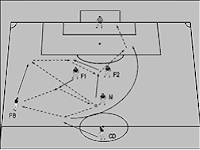
Soccer Practice Exercise #3
source : http://www.itsportsnet.com/leagues/1600/documents/futsalnotjustskills.doc

Read more!

Thursday, September 24, 2009

Developing Techniques to Play Futsal

Futsal has an important role for the development of soccer players talent. Concrete examples such as Brazil footballer. Most of the top players to play futsal in Brazil childhood. Like Ronaldinho, Pele, Zico, Socrates, and Bebeto. Thanks to playing futsal they could have the agility, speed and a very good intuition in the process of the skin round the field. Compared with soccer, Futsal rules much tighter. The player must not make a sliding tackle (tackle from behind) and charge body (body collisions), so players can get futsal technical ability without fear of being injured opponent.

There are several factors that help players in developing technical ability to play good ball:

1. Intelligence.

Here, soccer and futsal difference was seen. In futsal demanded a player can perform an improvisation in the face of problems in the play. So spontaneously player must be out technique. Futsal is ideal as a means of developing intelligence in playing soccer.

2. Technical Expertise.

Technique larger role of energy in playing futsal. If the techniques that have ineligible players, the players could not break away from pressing opponents. This condition makes the player inevitably must improve his skills. Both in terms of ball control, movement with and without the ball, footwork, passing, dribbling and shooting.

3. Total Football.

In futsal, a small number of players making all the players play a total football. So when the team attacked, not only the work forward. So did the last, the players also come down to help the defense. Therefore, futsal players are required to have excellent stamina, because it must always move.

4. Speed.

The narrow space makes the flow of fast moving ball between the players feet. So futsal players required to play fast, both in terms of passing, movement and shooting tricks. Of course it makes more value if used in playing a big football field.

5. Entertainment.
Futsal goal at the far more frequent than in football. With players of high skill, quick ball movement and frequent goal, futsal is a great spectacle.


Read more!

Thursday, September 17, 2009

Futsal Laws of the Game

Dimensions
The pitch shall be rectangular. The length of the touch line shall be
greater than the length of the goal line.
Length: minimum 25 m
maximum 42 m
Width : minimum 15 m
maximum 25 m

International matches
Length: minimum 38 m
maximum 42 m
Width: minimum 18 m
maximum 25 m

Pitch markings
The pitch shall be marked with lines. These lines belong to the areas of which they are boundaries. The two longer boundary lines are called touch lines. The two shorter lines are called goal lines. All lines shall be 8 cm wide. The pitch shall be divided into two halves by the halfway line. The centre mark shall be indicated at the midpoint of the halfway line. A circle with a radius of 3 m shall be marked around it. The pitch and its features are shown in the following diagram :

The penalty area
The penalty area shall be marked out at each end of the pitch as follows:

Quarter circles, with a 6 m radius, shall be drawn centred on the outside of each goal post. The quarter circles shall be drawn from the goal line to meet two imaginary lines 6 m in length drawn at right angles to the goal line from the outside of the goalpost. The upper part of each quarter circle shall be joined by a 3.16 m line running parallel to the goal line between the goalposts. The curved line marking the outer limit of the penalty area is known as the penalty area line.

The penalty mark
A mark shall be drawn 6 m from the midpoint between the goalposts and equidistant from them.
The second penalty mark
A second mark shall be drawn on the pitch 10 m from the midpoint between the goalposts and equidistant from them.
The corner arc

A quarter circle with a radius of 25 cm from each corner shall be drawn on the pitch.
Substitution zones
The substitution zones are the areas on the touch line in front of the
team benches that the players shall use to enter and leave the pitch.
  • the substitution zones are situated in front of the team benchesand are 5 m in length. They shall be marked at each end with a line 8 cm wide and 80 cm in length, 40 cm of which is drawn on the pitch and 40 cm off the pitch.
  • the area in front of the timekeeper’s table 5 m to either side of the halfway line shall be kept clear.

The goals
The goals shall be placed in the middle of each goal line. They shall consist of two upright posts equidistant from each corner and joined at the top by a horizontal crossbar. The distance (inside measurement) between the posts shall be 3 m and the distance from the lower edge of the crossbar to the ground shall be 2 m. The goalposts and the crossbar shall have the same width and depth, 8 cm. The goal lines shall be the same width as the goalposts and the crossbar. Nets, made of hemp, jute or nylon, shall be attached to the back of the goalposts and crossbar. The lower part of the nets shall be attached to curved tubing or another suitable means of support. The depth of the goal, i.e. the distance between the inside edge of the goalposts and the back of the net, shall be at least 80 cm at the top and 100 cm at ground level.

Safety
The goals shall have a stabilising system that prevents them from overturning. Portable goals may be used provided that they are as stable as normal goals.
Surface of the pitch
The surface shall be flat, smooth and non-abrasive. The use of wood or artifi cial material is recommended. Concrete or tarmac should be avoided.

Decisions
  1. If the goal lines are between 15 and 16 m in length, the radius of the quarter circle shall be 4 m. In this case, the penalty mark shall no longer be situated on the penalty area line but shall be drawn at a distance of 6 m from the midpoint between the goalposts
  2. A mark shall be drawn outside the pitch, 5 m from the corner arc and at right angles to the goal line to ensure that this distance is observed when a corner kick is taken. The width of this mark shall be 8 cm.
  3. Two additional marks, each at a distance of 5 m to the left and the right of the second penalty mark, shall be made on the pitch to indicate the distance to be observed when a free kick is being taken from the second penalty mark. The width of this mark is 6 cm.
  4. The team benches shall be situated behind the touch line, immediately beyond the free space in front of the timekeeper’s table.
for more details click here

Read more!

Tuesday, September 15, 2009

Futsal History


In recent years futsal begin to attract the attention of people in various parts of the world. the word "Futsal" comes from the Spanish of "Futbol" (soccer) and "Sala" (room), which combined means indoor football. According to FIFA, Futsal is the origin began in 1930 in Montevideo, Uruguay. Futsal was first introduced by Juan Carlos Ceriani, a football coach from Argentina. Rain is often flushed Montevideo upset him, because the plan was compiled to be messy because of flooded fields. Ceriani then move into the training room. First he kept using the number of players 11 people, but due to the narrow field, he decided to reduce the number of players to 5 people per team, including goalkeeper.
It turned out that indoor exercise is very effective and attractive. So as to attract much public interest in Montevideo. So many fans of football in the city who try this new game, and be loved sports Futsal public.

Version of the FIFA Futsal History can not be taken for granted, there are some countries who claim that Futsal comes from those countries respectively.

Canada and Brazil including the states that claim that Futsal comes from their country. They vigorously opposed the version of the FIFA Futsal history of this. Brazil claims that the same time as the emergence of the story Ceriani, soccer players in Brazil are doing the same thing, but in Brazil does not use a fixed rule, which means that the rules of each different region.

Futsal is growing very rapidly in Brazil, and in 1936 an agreement was made and the determination of rules of futsal. At that time, futsal rules are also not much difference with the current futsal rules. With this regulation, futsal is growing and popular in Latin America, even to the whole world.

In Italy, futsal was established in 1950. Futsal in Italy were introduced by the players, football players imports from Latin America who played in Serie A (Italian League). In free time, the players were playing futsal. And futsal dekenal and more popular in Italy.

Unlike the case with the UK. In England players often do football match practice six to six on grass. Futsal is also known in England, until some time held a futsal tournament sponsored by the London Express, one of the leading newspaper in London.

While in Spain, the development of futsal much faster. This can happen because of culture and style of playing football in Spain is very similar to Latin American culture.

In Futsal 1965 international competition held for the first time, with Paraguay's first champion. Then in subsequent years until the year 1979 Brazil was ruled competition. Brazil also won the Pan American trophy for the first time in 1980 and 1984.

In the year 1974 futsal meeting representatives from various countries. The meeting in Sao Paulo that initiated the formation of FIFUSA (The Federacao Internationale de Futebol de Salao / U.S. Futsal Federation) as an official organization that embodies futsal. FIFUSA when Joao Havelange was appointed as chairman. After this eksisnya futsal FIFUSA faster spread throughout the world.

First futsal world championship organized by FIFUSA in 1982 in Sao Paulo Brazil. In the first edition of this event came out as champions Brazil.

Three years later, the same event held in Spain. This is the first time this annual event three dihelat in continental Europe, and again came out as champions Brazil. And in 1988 Brazil was defeated by Paraguay in Australia.

After several years of existence, Futsal increasingly organized, and FIFA was interested. Because somehow helped promote futsal international football industry. In 1989 FIFA officially enter the futsal as one part of football, and FIFA also took over management of futsal world championship.

World Cup FIFA futsal first edition was held in the Netherlands in 1989 and the second was held in Hong Kong in 1992, with Brazil as a champion in the second edition.

With some consideration, ultimately changing the FIFA Futsal World Cup schedule is the four years.
source: http://www.infofutsal.com/category/sejarah-futsal/

Read more!